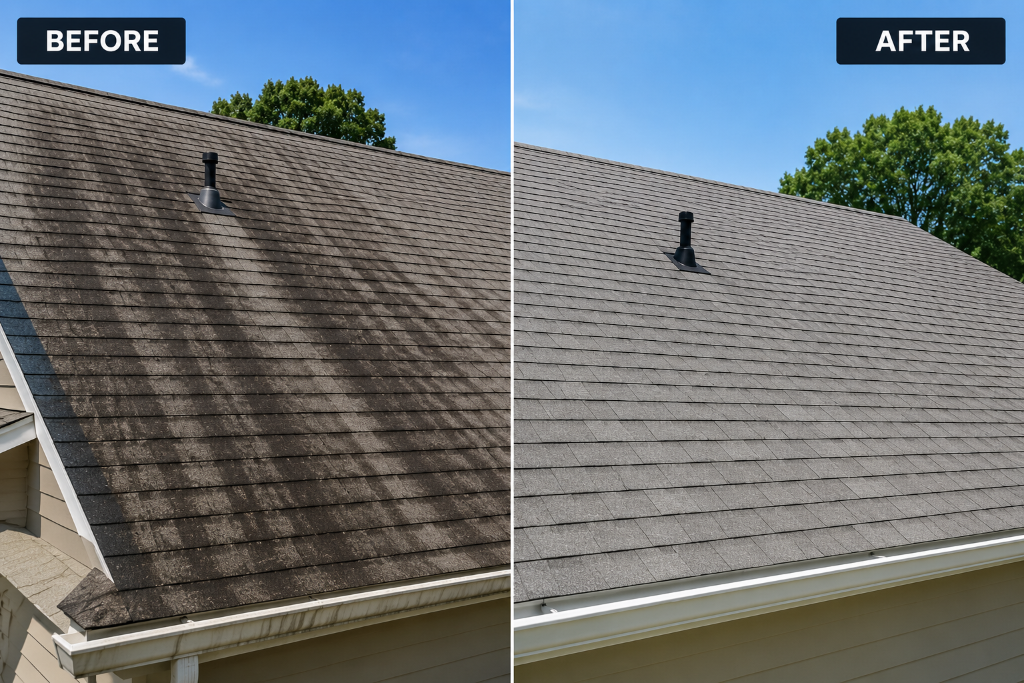
You're standing in the yard, looking up at your roof, and you see them — dark streaks running down from the ridge, spreading across the slopes. Maybe they started as faint lines a year ago. Now they're hard to miss. The roof looks old, stained, and tired.
If you're like most homeowners, you assume it's dirt. Maybe it's mold. Maybe the shingles are just wearing out. You might even be wondering if it's time for a roof replacement.
Here's the truth: those black streaks are not dirt. They're not mold. And they're probably not a sign that your roof needs replacing. They're a living organism — a specific type of algae — that's feeding on your shingles. And understanding what it is, how it grows, and how to remove it safely is the difference between a roof that lasts decades and one that fails prematurely.
What Is Gloeocapsa Magma?
The black streaks on your roof are caused by Gloeocapsa magma — a type of blue-green algae (technically a cyanobacterium) that has become one of the most common roofing problems in North America.
Why It's on Your Roof
Modern asphalt shingles contain a limestone filler — it's what gives the shingle body and weight. Gloeocapsa magma feeds on that limestone. In other words, the algae isn't just growing on your roof — it's eating your roof.
The algae arrived on your roof via airborne spores. Once it lands on a compatible surface (asphalt shingles with limestone filler), it colonizes and begins feeding. It spreads slowly at first, then accelerates as the colony grows.
What It Looks Like
Gloeocapsa magma appears as:
- ▸Dark vertical streaks running down from the roof ridge
- ▸Black or dark blue-green discoloration on individual shingles
- ▸Gradual spreading that gets worse year over year
- ▸Concentration on north-facing slopes and shaded areas
The streaks run downward because rainwater carries the algae cells down the slope of the roof, spreading the colony as it goes.
Why North-Facing Slopes Are Worst Hit
Gloeocapsa magma thrives in moisture and shade. North-facing roof slopes receive the least direct sunlight, which means they stay damp longer after rain and dew. In the humid North Texas climate, that's the perfect growing environment. South-facing slopes that bake in the sun are much more resistant to algae growth.
The Science of Roof Algae Growth
Understanding why your roof is growing algae requires understanding the conditions that support it:
Moisture
The Texoma area's humidity — which regularly exceeds 70% from spring through fall — keeps roof surfaces damp, particularly overnight. Dew settles on shingles every morning, providing the moisture algae needs to survive and grow. Properties near Lake Texoma or in low-lying areas experience even higher ambient moisture.
Temperature
Gloeocapsa magma grows most aggressively between 60°F and 85°F. In North Texas, that temperature range describes a significant portion of the year — from March through October. Unlike northern climates where winter freezing kills or slows algae, our mild winters allow it to continue growing, just at a reduced rate.
Food Source
The limestone filler in modern asphalt shingles is the food source. This is a relatively recent problem — older shingle formulations used different fillers that weren't as hospitable to algae. Most shingle manufacturers now add algae-resistant granules (copper or zinc oxide), but these degrade over time, and many roofs were installed before this technology was standard.
Shade
Trees, nearby buildings, and roof orientation all affect how much sunlight reaches the surface. Shaded roof slopes — whether from trees or the home's own orientation — dry more slowly and are more vulnerable to algae colonization.
Airborne Spores
Algae reproduces via airborne spores, which means it can spread from neighboring roofs. If homes in your area have algae growth, spores can travel on the wind and colonize your roof — even if your roof was recently cleaned.
The Damage: What Algae Actually Does to Your Roof
Gloeocapsa magma isn't just a cosmetic problem. Left untreated, it causes real damage:
Shingle Degradation
The algae feeds on the limestone filler in the shingles. Over years, this consumption breaks down the shingle matrix, contributing to:
- ▸Granule loss — the protective ceramic granules on the shingle surface loosen and wash away
- ▸Reduced shingle life — a roof that should last 25-30 years may need replacement in 18-22 years
- ▸Surface deterioration — the shingle becomes more porous and vulnerable to further damage
Increased Energy Costs
Dark algae streaks change the reflectivity of your roof. Instead of reflecting sunlight, the darkened surface absorbs it — raising the temperature of the roof and the attic below. In North Texas summers, this can increase cooling costs as your HVAC system works harder to overcome the added heat load.
Accelerated Growth of Other Organisms
Where Gloeocapsa magma establishes, other organisms often follow. Moss and lichen can take hold on algae-colonized surfaces, causing more serious damage:
- ▸Moss — grows into shingle edges and underlaps, lifting shingles and creating water intrusion paths
- ▸Lichen — attaches firmly to shingle granules and can cause pitting when it's removed
Reduced Property Value and Curb Appeal
A roof with prominent black streaks looks old and failing — even if the shingles have years of remaining life. This affects:
- ▸Home value — buyers and appraisers perceive a streaked roof as nearing end-of-life
- ▸Time on market — a dirty roof can deter buyers and extend time on market
- ▸Neighborhood perception — a streaked roof affects the entire street's appearance
Common Myths About Roof Stains
Myth 1: "It's Just Dirt"
No. The black streaks are a living organism — algae that's feeding on your shingles. Dirt would wash off in the rain. Gloeocapsa magma is rooted into the shingle surface and actively growing.
Myth 2: "It Means I Need a New Roof"
Not necessarily. Black streaks indicate algae growth, not shingle failure. A roof with algae can have years of remaining life — the stains are removable with proper soft-wash treatment. However, if the algae has been left untreated for many years and the shingles are physically degrading, a roof inspection is warranted.
Myth 3: "Pressure Washing Will Remove It"
Pressure washing will remove the visible algae — but it will also destroy your roof. High pressure strips the protective granules off asphalt shingles, shortens the roof's life, and voids manufacturer warranties. This is the single most damaging thing you can do to a roof. Never pressure wash a roof.
Myth 4: "Bleach Will Kill It"
Chlorine bleach will kill algae — but using it improperly can damage your landscaping, corrode metal gutters and flashings, and affect the shingle surface. Professional roof cleaning uses specialized, roof-friendly detergents at the correct dilution, applied at low pressure, with full landscaping protection. DIY bleach applications often cause more harm than good.
Myth 5: "It Won't Spread"
It will. Algae spreads across the roof surface as the colony grows, and it can spread to neighboring roofs via airborne spores. A small streak today can cover an entire slope within 2-3 years if left untreated.
The Correct Solution: Soft-Wash Roof Treatment
The safe, industry-recommended method for removing Gloeocapsa magma and other roof organisms is soft washing — a low-pressure treatment with specialized cleaning solutions.
How It Works
- ▸Roof inspection — identify the type and extent of algae, moss, or lichen; assess shingle condition; determine safe access points
- ▸Property preparation — protect landscaping, outdoor furniture, gutters, and surrounding areas
- ▸Landscaping pre-wet — all flower beds, grass, and shrubs are pre-wet with clean water to protect vegetation from any runoff
- ▸Soft-wash application — specialized roof-cleaning detergent is applied at very low pressure — never high pressure — that targets and kills algae, moss, and lichen at the root
- ▸Controlled dwell time — the treatment is allowed to work, breaking down the organisms so they can be naturally rinsed away
- ▸Gutter and valley clearing — debris is cleared from gutters and roof valleys to ensure proper drainage
- ▸Final inspection — full coverage confirmed, protected areas checked, property walked with the homeowner
Why It Works Better Than Pressure Washing
Soft washing kills the organism at the root. Because the algae is dead — not just blasted off the surface — it doesn't regrow quickly. A properly soft-washed roof typically stays clean for 2 to 3 years, compared to weeks after a pressure wash that merely rinses off the visible layer.
Why It's Safe
- ▸No high pressure — the solution does the work, not force. Shingle granules stay intact. Warranties are preserved.
- ▸Roof-friendly detergents — specialized cleaning solutions formulated for roof application, not harsh household chemicals
- ▸Minimal foot traffic — in most cases, cleaning is done from the ladder line, minimizing walking on shingles
- ▸Full property protection — landscaping, gutters, and surrounding areas are protected throughout
The North Texas Factor
In Sherman, Denison, Pottsboro, and the surrounding Texoma area, roof algae is particularly aggressive. Our climate stacks every condition Gloeocapsa magma needs:
- ▸High humidity from spring through fall
- ▸Warm temperatures for most of the year
- ▸Heavy spring pollen that provides additional organic matter
- ▸Lake proximity that increases ambient moisture
- ▸Mature tree canopies that provide shade
Properties near Lake Texoma — Pottsboro, Kingston, and lakeside communities — often see the fastest algae growth due to elevated humidity. Homes in wooded neighborhoods across Sherman and Denison also develop streaks quickly on shaded roof slopes.
For most Texoma homes, roof cleaning every 2 to 3 years keeps algae under control and protects the shingles from premature degradation.
When to Schedule Roof Cleaning
If you're seeing any of the following, it's time to schedule a soft-wash roof treatment:
- ▸Dark streaks visible from the ground
- ▸Black discoloration spreading across any roof slope
- ▸Green or dark patches indicating algae or moss growth
- ▸Crusty white or gray spots indicating lichen
- ▸A roof that looks older than it should for its age
- ▸Neighbors' roofs showing algae growth (yours may be next)
Don't wait until the algae has caused real shingle damage. Early treatment is more effective, less expensive, and protects the long-term integrity of your roof.
Protect Your Roof the Right Way
Those black streaks aren't just an eyesore — they're a living organism actively feeding on your shingles. The good news is that safe, effective treatment is available.
Texoma Pressure Washing provides professional roof cleaning throughout Sherman, Denison, Pottsboro, and the surrounding Texoma area. We use soft-wash treatment — never high pressure — to kill algae, moss, and lichen at the root while protecting your shingles, your landscaping, and your warranty.
Request a free quote or call (903) 444-2704 — let's remove those black streaks and protect your roof the right way.
Want to learn more about protecting your home's exterior? Read about how North Texas weather affects your home, or explore our full range of exterior cleaning services.
Frequently Asked Questions
Related Service
Roof Cleaning
Safe, low-pressure soft wash roof cleaning in Sherman, Denison & across Texoma. Remove black streaks, algae, and moss without damaging your shingles.
Learn About This Service